


UK Skills Shortage Solutions: Strategic Workforce Planning for 2026
Did you know that 73% of UK businesses are still struggling to find skilled talent in 2026? Whilst the total number of vacancies has dipped since the pandemic, the difficulty in securing specialist expertise remains a persistent barrier to growth. You’ve likely experienced the frustration of high recruitment costs resulting in poor candidate quality. It’s a common challenge, but finding effective UK skills shortage solutions is no longer just about posting to generic job boards. It requires a more methodical, verified approach to talent acquisition.
We understand that operational delays caused by unfilled roles can stifle your momentum. It’s difficult to decide whether to hire permanent staff or use contractors when the market feels so unpredictable. This article provides a clear framework for strategic workforce planning to help you overcome these hurdles. You’ll discover how to reduce your time-to-hire for specialist roles and gain access to a wider network of verified professionals. By the end of this guide, you’ll have the tools to secure the expertise your business needs to thrive.
Key Takeaways
- Identify why traditional recruitment methods are failing in the 2026 economy and how to navigate high-demand sectors like engineering and digital services.
- Discover practical UK skills shortage solutions by balancing internal upskilling programmes with efficient external access to specialist expertise.
- Learn a methodical 5-step framework to build a resilient talent pipeline, starting with a comprehensive audit of your current and future skills requirements.
- Reduce time-to-hire and recruitment overheads by bypassing generic search engines in favour of a national directory of verified professionals.
- Mitigate the risk of bad hires by utilising bespoke recruitment services that provide structured vetting for both temporary and permanent roles.
Navigating the 2026 UK Skills Landscape
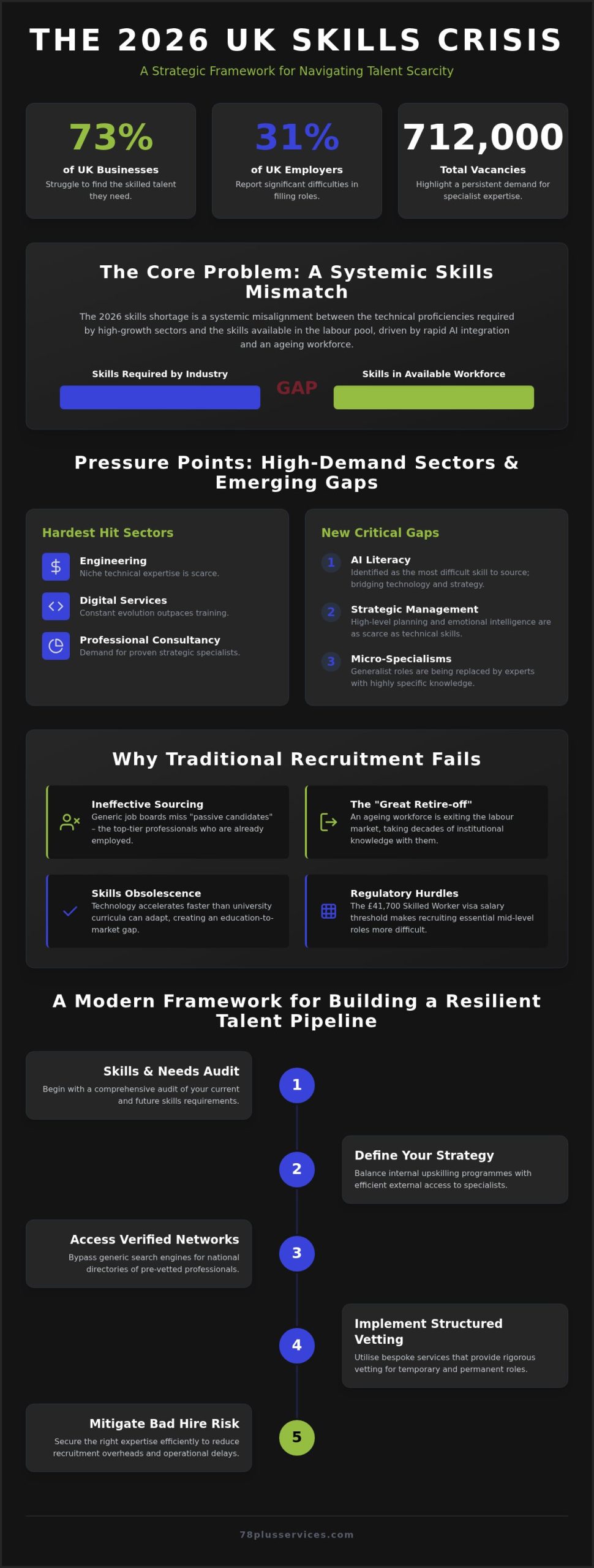
The 2026 economy is characterised by a unique paradox. While total vacancies have fallen to 712,000, 31% of UK employers report significant difficulties in filling roles. This isn’t a simple lack of workers. It is a profound structural unemployment and the skills gap issue. High-demand sectors like engineering, digital services, and professional consultancy are the hardest hit. Businesses searching for UK skills shortage solutions must look beyond traditional recruitment to find the niche expertise required today.
In 2026, the UK skills shortage is defined as a systemic misalignment between the technical proficiencies required by high-growth sectors and the available labour pool, driven by rapid AI integration and an ageing workforce.
The “Mismatch Gap” occurs when the workforce is willing to work, but their existing qualifications don’t align with the requirements of modern roles. Economic shifts have simply outpaced the speed of workforce retraining. Consequently, the talent you need exists, but it’s often fragmented across professional networks rather than sitting on traditional job boards.
The State of the UK Labour Market
Current vacancy trends show that pressure is concentrated in specific areas. In the second quarter of 2026, 23% of employers in construction and healthcare anticipated significant recruitment hurdles. The shift toward hybrid and remote work has also altered the competitive field. You’re no longer just competing with the business down the road. You’re competing with national entities that can offer higher-weighted salaries for remote roles.
Regulatory changes have further complicated the landscape. The standard minimum salary for a Skilled Worker visa is now £41,700. This threshold pushes many businesses to focus on higher-skilled, RQF Level 6 roles, making it harder to recruit for essential mid-level positions. It’s a tight market that demands a more organised approach to sourcing talent.
Emerging Gaps in Professional Services
We’re seeing a sharp rise in the demand for “Micro-Specialisms.” Generalist roles are being replaced by niche experts who possess highly specific technical knowledge. For the first time in 2026, AI literacy has been identified as the skill organisations find most difficult to source. This isn’t just about coding; it’s about the confidence to integrate AI into daily operations.
Soft skills haven’t escaped the shortage either. Strategic management and emotional intelligence are now as scarce as technical proficiency. Businesses are moving away from hiring “jacks of all trades” and are instead looking for verified specialists who can deliver immediate value. This shift requires a reliable way to connect with experts who have already been vetted for their specific capabilities.
Root Causes: Why Traditional Recruitment is Failing
Generic job boards are no longer effective for sourcing high-level expertise. These platforms often attract active job seekers who may lack the specific technical depth required for modern roles. In 2026, the most qualified professionals are rarely browsing listings. They’re “passive candidates” who are already employed and only move for specific, targeted opportunities. This shift makes traditional UK skills shortage solutions, like high-volume advertising, increasingly obsolete.
Demographics play a critical role in this decline. The UK is facing a “Great Retire-off” as an ageing workforce exits the labour market. This exodus is taking decades of institutional knowledge with it. Simultaneously, technological acceleration means that technical skills often become obsolete faster than universities can update their curricula. According to Skills England’s Annual Skills Report, there is an urgent need to align technical education with these rapidly changing labour market requirements to prevent long-term stagnation.
Digital Literacy and the AI Transition
Automation has created a new tier of required competencies. It’s no longer enough to be technically proficient; professionals must now bridge the gap between technology and business strategy. Finding individuals who can navigate AI integration whilst maintaining a strategic overview is exceptionally difficult. Internal training programmes often fail to keep pace with these innovations because they lack the agile structure needed to adapt to monthly software shifts. Many organisations find that sourcing pre-vetted specialists through a professional service directory is a more efficient way to close these gaps quickly.
The Shift in Professional Behaviour
Top-tier UK professionals are moving toward “Portfolio Careers.” Instead of seeking traditional 9-to-5 permanent roles, they prefer to offer their expertise across multiple projects. This shift in behaviour means that reputation management and visibility are more important than a static CV. Experts now prefer to be listed amongst peers in verified networks where their specific skills are easily discoverable by businesses. Reputation is the new currency. In 2026, the best talent isn’t looking for you; they’re waiting for you to find them in the right professional ecosystems.
Strategic Solutions: Internal Growth vs. External Access
Deciding between internal development and external acquisition is the central challenge in finding effective UK skills shortage solutions. Upskilling your existing workforce offers long-term stability and cultural alignment, but it rarely meets immediate operational needs. Conversely, external hiring provides instant expertise but comes with higher upfront costs and competition. The most successful organisations in 2026 use a “Hybrid Talent Model.” This approach maintains a core permanent team whilst integrating a flexible layer of specialist contractors to handle technical surges or niche projects.
The Case for Reskilling and Upskilling
Investing in your current team is a vital strategy for retention. It builds a “learning culture” that makes your business more attractive to top-tier talent. However, private training investment in the UK has fallen by £10.6 billion since 2011. This decline has forced businesses to rely more heavily on the Apprenticeship Levy and other government incentives to fund their 2026 training budgets. Whilst these programmes are excellent for foundational growth, they don’t solve the problem of missing high-level technical skills that take years to master.
Internal training often hits a ceiling when dealing with “Micro-Specialisms.” If your business needs urgent AI literacy or advanced engineering expertise, a three-year apprenticeship isn’t a viable solution. You’re left with a choice: wait for your team to catch up or find a verified expert who can deliver value immediately. Most leaders find that a mix of internal growth for generalist skills and external access for specialist roles creates the best balance of cost and agility.
Leveraging External Professional Networks
When immediate gaps threaten project delivery, external networks are your most reliable asset. For roles in IT, engineering, or construction, you can consult the Skilled Worker visa shortage list to facilitate international sponsorship. Under these rules, the minimum salary threshold is often lowered to £33,400, making specialist recruitment more accessible. However, international sponsorship is complex and time-consuming. It’s often more efficient to look for domestic expertise through organised professional channels.
Utilising a “Professional Marketplace” transforms recruitment from a reactive chore into a strategic advantage. Instead of sifting through thousands of unverified CVs, you can access a national database of professionals who have already been vetted. This bypasses the traditional recruitment bottleneck and reduces your time-to-hire significantly. Accessing a directory of specialists allows you to find the exact expertise you need without the uncertainty of generic job boards. This methodical approach ensures you aren’t just filling a vacancy; you’re securing a verified professional who can hit the ground running.
Building a Resilient Talent Pipeline
Securing specialist expertise in 2026 requires more than a reactive hiring policy. It demands a structured, five-step framework designed to navigate a tight labour market. By implementing these UK skills shortage solutions, you can transform your recruitment from a constant struggle into a streamlined, repeatable process. A resilient pipeline ensures that your operations aren’t stalled by the sudden departure of a key specialist or a shift in technological requirements.
- Step 1: Conduct a “Skills Audit”. Map your current team’s proficiencies against your strategic goals for 2026 and beyond. Identify exactly where your gaps exist today and where they’ll appear in eighteen months.
- Step 2: Diversify Sourcing Channels. Move beyond saturated social networks and high-volume job sites. Seek out niche professional networks and curated directories where specialists actually manage their reputations.
- Step 3: Implement Robust Vetting. In a competitive market, speed is essential; however, verification cannot be sacrificed. Use structured listing plans that provide pre-vetted data to ensure candidate quality.
- Step 4: Optimise Candidate Experience. Top-tier talent often holds multiple offers. Ensure your communication is clear, your interview stages are concise, and your feedback is immediate.
- Step 5: Partner with Specialist Platforms. Leverage professional directories and bespoke recruitment services to access talent that isn’t visible on the open market.
Utilising Professional Directories for Efficiency
Searching a curated directory of professionals is far more efficient than a generic web search. Generic search engines often return a wall of unverified results, forcing your HR team to spend hours filtering through irrelevant CVs. A professional listing provides immediate transparency regarding an expert’s experience and verification status. When you reach out to these experts directly, you’re engaging with a “passive candidate” who has already demonstrated their commitment to professional standards. It’s a faster, more organised route to securing the exact expertise your business requires.
Streamlining Recruitment with Expert Facilitators
Bespoke recruitment services are invaluable in a candidate-short market. These facilitators handle the heavy lifting of sourcing and initial vetting, allowing your leadership team to focus on final selections. This methodical approach significantly reduces the “Risk of a Bad Hire”, which is a costly mistake in a high-salary environment. By using a national database of service professionals, you gain access to a wider, more reliable network than any single internal HR department could maintain alone. To begin building your resilient pipeline, you can access our professional service directory and connect with verified specialists today.
How 78+ Services Bridges the UK Skills Gap
In a market where 73% of businesses report difficulties finding talent, 78+ Services acts as a methodical guide. We provide the essential infrastructure needed to implement effective UK skills shortage solutions through a national database of vetted professionals. Our role is to simplify the complex process of talent acquisition by serving as a knowledgeable intermediary. By using our structured listing plans, you bypass the chaos of unverified job boards and gain access to a reliable engine of professional expertise that spans the entire UK.
Bespoke Recruitment for Permanent and Temporary Needs
Our bespoke recruitment services are designed to manage the entire lifecycle of sourcing for both permanent and temporary needs. We understand that a “one size fits all” approach fails in a specialist market. Instead, we use a tailored methodology to identify candidates who are a perfect technical and cultural fit for your organisation. For project-based gaps or seasonal surges, our temporary services provide immediate relief without the long-term commitment of a permanent contract. We manage the heavy lifting of end-to-end vetting, ensuring that every professional is verified before they reach your interview stage. This systematic approach reduces the risk of operational delays and ensures your business maintains its momentum.
Accessing a Curated Network of Experts
The core of our offering is the Service Professional Directory, which provides instant access to a curated network of experts. We organise our listings to ensure that data is easy to navigate, making the process of finding the right professional stress-free and efficient. Our Professional Listing Plans benefit both the seekers and the providers by maintaining a high standard of quality assurance throughout the network. This directory serves as a strategic asset for businesses that need to move faster than traditional recruitment allows. By connecting you directly with verified specialists, we help you overcome the fragmentation of the current labour market and secure the expertise your business needs to thrive.
Find the experts you need on our Professional Service Directory
Future-Proofing Your Business for 2026 and Beyond
The 2026 labour market requires a fundamental shift from reactive hiring to strategic workforce planning. Success no longer depends on high-volume job postings but on accessing a verified network of specialists who can deliver immediate value. By implementing a structured 5-step talent pipeline and embracing a hybrid model of permanent and temporary expertise, you can bypass the traditional recruitment bottleneck.
Finding effective UK skills shortage solutions starts with moving beyond generic search engines. You need a methodical guide that has already handled the heavy lifting of vetting and organisation. Our national network of verified professionals and bespoke recruitment solutions ensure that your business stays agile, regardless of how the economic landscape shifts. We provide a streamlined, expert-led vetting process designed to reduce your time-to-hire and eliminate the risk of a bad hire.
Explore our UK Professional Directory and find your next expert today. With the right partners and a clear strategy, your business won’t just survive the talent gap; it’ll thrive within it.
Frequently Asked Questions
What are the main causes of the UK skills shortage in 2026?
The main causes include an ageing workforce and rapid technological acceleration that outpaces traditional education. In 2026, the emergence of an AI literacy gap has created a new tier of required competencies that many workers don’t yet possess. These structural issues mean that finding sustainable UK skills shortage solutions requires a move away from passive recruitment toward active, strategic workforce planning.
How can a professional directory help my business find staff?
A professional directory provides instant access to a national database of experts who manage their own professional reputations. Unlike generic search engines, a directory organises data into digestible blocks to make finding the right specialist seamless. This approach allows your business to bypass the noise of traditional job boards and connect directly with passive candidates who aren’t actively browsing active listings.
What is the difference between temporary and permanent recruitment services?
Temporary recruitment services address project-based gaps or seasonal surges, providing immediate expertise without a long-term contract. Permanent services focus on identifying candidates who offer a perfect cultural and technical fit for sustained growth. Both options utilise bespoke recruitment management to handle the sourcing and vetting process, ensuring that every hire meets the high standards required for specialist roles in 2026.
Is it better to reskill current employees or hire new experts?
The decision depends on your timeline and the specificity of the required skill. Reskilling current staff is excellent for long-term retention and cultural alignment, though it requires significant time investment. For immediate technical gaps, hiring niche experts provides effective UK skills shortage solutions. Most successful organisations use a hybrid model, developing their core team whilst accessing external specialists for high-level technical surges.
How do I know if a professional in a directory is properly vetted?
Professionals are verified through structured listing plans that require them to provide specific evidence of their expertise and experience. 78+ Services acts as a knowledgeable intermediary, handling the heavy lifting of filtering and organising these options. This systematic vetting process ensures that every individual in the directory meets professional standards, reducing the stress of recruitment and the operational risk of a bad hire.
What sectors in the UK are currently facing the worst labour shortages?
In 2026, sectors such as construction, healthcare, and engineering face the most acute difficulties. Specifically, 23% of employers in the care and social work sectors expect significant hurdles in filling vacancies. Digital services and IT also struggle with a lack of AI-literate professionals. These industries require a more methodical approach to talent acquisition to overcome the fragmentation of the current labour market.
How much does it cost to use a recruitment agency for specialist roles?
Recruitment agencies typically earn revenue through professional fees for placement services or subscription fees for directory access. The cost varies based on the complexity of the role and whether the requirement is for temporary or permanent staff. Using an expert facilitator saves your business money in the long run by reducing the time-to-hire and ensuring you don’t waste resources on unverified candidates.
Can small businesses benefit from professional listing plans?
Yes, small businesses can use professional listing plans to increase their market visibility and reach a broader client base. These structured packages allow smaller entities to showcase their expertise alongside larger competitors in a national database. It provides a cost-effective way to facilitate direct connections with potential customers without the need for an extensive internal marketing or HR department.


Leave a Reply